

Parramatta District Cricket Club (Cumberland) Initial First Grade Premiership 1899-1900
Parramatta District Cricket Club | July 28, 2026
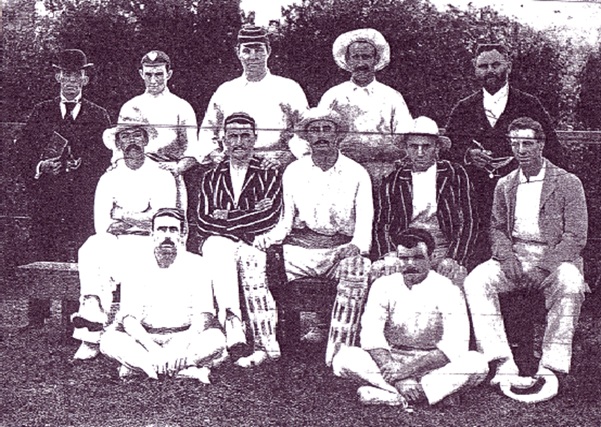
A rare photo of this illustrious team came to light in The Sydney Mail newspaper, Saturday 4th April 1900.
Back Row: A. Ryan (12th), C.E. Simpson, J.C. Wilson, W.P. Howell, A.W. Green (Official & delegate to NSWCA).
Middle Row: J.E. Anthony, L.W. Pye, W.D. Loveridge (Capt.), B.W. Farquhar, E.L. Waddy.
Front Row: E. Miller, A. Hull.
The strong nucleus of this team had been together for several seasons, narrowly missing premiership honours in 1894/95 and 1896/97, and with First-class players in Howell, Pye, Wilson, Farquhar, Loveridge and Waddy in its ranks, the winning of the Hordern Shield was somewhat inevitable, and success finally arrived in 1899/00. Considering that the games were played on uncovered wickets and that the season consisted of just 9 matches (winning 7, losing 1 and drawing 1) the seasonal statistics of the major players stand the test of time.
The 1899-00 1st Grade Premiership team contained several personality players. There was Joe Wilson, left-handed all-rounder, who has achieved local immortality as the man who bowled the great W.G. Grace for a duck at Parramatta in 1891. There was Les Pye, scorer of 166 at his first inter-colonial appearance, and who, the previous season, had scored 244 and taken 9/40 against Leichhardt, an all-round feat unequalled in the history of Sydney 1st grade cricket.
The dashing Wally Farquhar, acclaimed as second only to Trumper in sheer brilliance, generally opened the innings, accompanied by the exuberant youngster from Kings School, (‘Gar’) Waddy, already a NSW player, and later to twice tour New Zealand with Australian Eleven teams. The wicketkeeper was Wally Loveridge, rated by the older generation as the best keeper Cumberland has had, a former NSW captain against Queensland, and State representative against England in 1894.
From the lower grade for four matches came Charlie Simpson, a youth of great promise, who later played for NSW, and after moving to Brisbane represented Queensland at both cricket and Rugby Union. But overshadowing them all, the popular idol of the cricketing public was the breezy, happy bee farmer from Penrith, Bill Howell. A series of spectacular performances had sky-rocketed him to fame, starting with his debut for NSW in 1894. Chosen as a batsman, he took five wickets to bundle out a strong English team after the regular bowlers had been well collared. Against the 1897/98 English team, he struck again. Straining a leg muscle in the field, he limped to the crease as last man in the second innings with Victor Trumper to run for him. The runner had very little running to do. In 63 minutes, Howell hammered the attack to the tune of 95 runs, adding 109 for the last wicket with Andy Newell. Finally came his sensational debut on English soil with the 1899 Australian team. Against Surrey, he proved unplayable, capturing all ten wickets for 28 runs in the first innings and a further 5/29 in the follow-on (15 / 57 for the match).
Because of the tour Howell arrived home too late to take part in Cumberland’s first three matches in 1899/00. However, the first two games, against Waverley and Burwood, were won comfortably, thanks to a Farquhar century, some steady batting from Ned Miller, the team’s utility batsman, and good bowling by Wilson, Pye and a youngster from King’s School, name Middleton. In scoring his 141, Farquhar added 54 for the first wicket with Loveridge, who scored 72. The third game against South Sydney was virtually washed out by rain, but Waddy was prominent in the next against Leichhardt, with 133 in a total of 239. Howell and Pye successfully contained Leichhardt.
Farquhar’s greatness was demonstrated in the following game against the strong North Sydney team. Cumberland were sent in on a pitch heavily over-watered and were all out for 104. Farquhar carried his bat through the innings for 55 not out, being the only double figure scorer. North Sydney in their turn was powerless against Howell and Pye and eventually lost outright. H.S. Hawkins made his only 1st grade appearance with Cumberland in this match and was unfortunate to collect the dreaded pair.
The Paddington match brought the only defeat in a low scoring game on a wet wicket, interrupted by rain. M.A. Noble and Howell dominated the match, and Cumberland lost narrowly on the first innings. Fast scoring occurred against Redfern, Les Pye making 100 in 70 minutes, and Howell 62 in 30 minutes. Apart from two singles, a two and a three, Howell’s scoring strokes were either to or over the boundary.
Pye scored another century against East Sydney and then came the last match against Glebe. The competition was conducted based on first-past-the-post, and a draw would have suited Cumberland. Rain completely washed-out play on the first day, and a wet wicket faced the players on the second day. Cumberland scored 127, thanks to Waddy 48 and Pye 38, and this was more than enough, Pye (6/27) and Howell (4/17) bowling unchanged to tumble Glebe out for 56. Thus, Central Cumberland - who had been runners-up in 1894/95 and 1896/97 and third in 1895/96 - at last achieved their first Premiership.
Only nine matches were played, it being the custom in 1899 to suspend 1st grade games whenever the NSW team was playing either at home or away. This generally resulted in at least four blank Saturdays each season, and in 1899, a New Zealand team was here also. Incidentally, Farquhar greeted them with a brilliant 110 for NSW.
Farquhar, Pye, Loveridge, Miller and Arthur Hull played all nine games. Waddy in eight, Wilson and Middleton in seven, Howell in six. Hull was a champion concrete wicket batsman from Liverpool. A neat left-hander from Maitland, Ray Lindsay played successfully in two matches, scoring 19, 38 not out and 55. George Jordan, a capable wicket-keeper batsman who later played with Gordon appeared in four matches, the same number as A. Ryan, a moderate batsman, who acted as scorer when not playing. Others to make the occasional appearances were H. Lloyd, L. Brown, A. Parks, H. Woods, and J. Anthony.
E.L. Waddy headed the batting averages with 374 runs at 46.7 (best – 133 v. Leichhardt, 66* v. Paddington, 48 v. Glebe) followed by W.B. Farquhar 389 at 43.2 (best – 141 v. Burwood, 55* v. North Sydney, 70 v. East Sydney) and L.W. Pye 382 at 42.4. (Best – 133 v. East Sydney, 100 v. Redfern, 39 v. Waverley) Miller and Howell averaged 20, Jordan and Hull 17, Loveridge 14 and Wilson 12. The veteran Wilson, scorer of centuries in earlier years and a NSW player, tended to languish from lack of opportunity. W.P. Howell headed the bowling averages, taking 33 wickets @ 9.5 (best – 4/44 v. Leichhardt, 4/25 & 5/42 v. North Sydney, 4/44 v. Paddington, 5/55 v. Redfern, 5/57 v. East Sydney, 4/17 v. Glebe) with three bags of five victims, four of four and one of two. His average was the best in the Association. L.W. Pye took 31 wickets @ 14.7 (best – 6/32 v. Burwood, 6/27 v. Glebe, 4/33 & 3/32 v. North Sydney) with accurate leg-spinners, twice capturing six wickets in an innings. When Howell joined the team, Middleton and Wilson found their bowling opportunities restricted, even though they had each taken six wickets in an innings early in the season. Middleton finished with 13 @ 14.5 (best – 6/44 v. Waverley, 3/37 v. Leichhardt) and Wilson 10 @ 16.7 (best – 6/15 v. Waverley). Farquhar, who was often given a couple of quick overs and would snare a cheap wicket took 9 at 9.4 (best – 2/8 v. Burwood, 2/5 v. Paddington, 2/12 v. Leichhardt), and Woods at his only appearance, took 3/13. Lindsay outshone them all, taking one wicket for none.
With such bowlers, it was not surprising that the highest score against Cumberland was 169 by Waverley in the first match of the season. Cumberland topped 300 on three occasions, with 356 against Redfern as the highest. The fielding was apparently very good, with Waddy, Farquhar and Miller brilliant. Simpson strengthened this department whenever he played and Loveridge and Jordan were excellent wicketkeepers.
The team had been a powerful combination and flourished in an era which has been described as the Golden Age of Central Cumberland cricket. In fact, thirty years later, a letter in the Sydney Press described them as the strongest club side ever assembled in Sydney. Such controversial comment may well be challenged by several glittering club sides, but it was a graceful tribute from an unknown source to an Eleven that must have possessed great skill and brilliance.
By Tom Wood – Parramatta District Cricket Club Historian