
Parramatta District Cricket Club and Parramatta Park – A Historical Association
Parramatta District Cricket Club | March 31, 2026
The Parramatta District Cricket Club has shared an incredible enduring relationship with Parramatta Park, an association that had its start way back in the late 1850s and continues to this present day, no other Sydney Premier Cricket Club can match this statement.
Parramatta Park –
The precinct that is known as Parramatta Park was an area of great historical significance in the pioneering days of the new colony of New South Wales. Early November 1788 Governor Arthur Phillip established a military outpost at Parramatta (then known as Rose Hill), and convicts were sent there to commence farming, and this project became the first farm to produce sufficient food to feed the penal colony thus saving the new settlement in Sydney from starvation.
In 1790 Governor Phillip continued to advance Parramatta by laying out the area of the government Domain as part of the township. Located on the western edge of the original township it contained a Governor’s residence – Old Government House was used by successive Governor’s until 1855, and this notable building is preserved as a tourist attraction to the present day, standing as the oldest vice-regal residence in Australia – stockyards, lumber yards, a redoubt, food cultivation and grazing areas were all part of the domain.
In the 1840s a group known as the Parramatta Park Movement pushed hard for more public access to the Government Domain, and this resulted in Governor Fitzroy authorizing a Race Course (Cumberland Turf Club) to be constructed north of the river – the course occupied a significant area extending from the river in the west to O’Çonnell Street in the east. In modern days this area would contain Old Kings Oval and Bankwest Stadium – the Cumberland Turf club reigned from 1847 to 1858 before being replaced by the Mud Lodge Races whose duration spanned the years 1858 to 1883, after which Horse Racing activities were transferred to the modern site of the racetrack at Rose Hill.
The opportunity for more sporting activities in the park arose in 1857 when the western section of the domain was offered for sale and the Parramatta Park Act of 1857 was passed providing 246 acres, to be managed by Trustees, for public use and granted as a park for ‘promoting the health and recreation of the inhabitants of the town of Parramatta’.
Parramatta Cricket Club and the Park -
After a nomadic existence of playing local matches anywhere there was an available patch of grass – Barracks ground, Newlands Estate, Harris Meadows and the old Gaol green – the Parramatta Cricket Club started to conduct matches after 1857 on the Western or Back domain of Parramatta Park (Westmead area).
Needing a permanent home-base to advance the cricket club’s profile, in 1862 the enthusiastic President Doctor George H. Pringle petitioned the Parramatta Park Trustees for permission to build a cricket field within the boundaries of the existing horse racing track. The permission was forthcoming and the cricketers then toiled for twelve months with picks and shovels levelling and clearing the rough land to create their field of dreams. The first match being married v. single was played in March 1863 – the field was surrounded by a post and rail fence. With no on tap water supply system and rain being the only watering agent, the quality of the pitch surfaces was pretty ordinary for a couple of decades.
The responsibility for the maintenance and equipment, facility improvements, staff appointments and ground hire were all entrusted to the Parramatta Cricket by the Park Trustees under the terms of a lease agreement that was renegotiated at various intervals. The cricket club’s volunteer Ground Committee continued to undertake these duties and responsibilities through to 1st January 1936, when the task became too onerous for volunteers to continue in the wake of the 1930s post Great Depression years, and the Park Trust took over control of the oval with the Parramatta Cricket Club settling for the payment of an annual rental fee to ensure their continued tenancy.
Under the guidance of a strong and progressive management team headed by the likes of President Hugh Taylor, Secretary W.A. Brodie and Treasurer J.J. Miller the Parramatta Cricket Club gradually forged ahead in the 1870s and 1880s, and so did Parramatta Oval under the club’s control. A glance at some of the events associated with the oval during this period of the club’s guardianship reflects its staged development towards a top-drawer colonial era sporting venue:
- 1874 “The club set to work in earnest to make a county ground of it – placing a picket fence around it and planting trees” – The Jubilee History of Parramatta (p. 138).
- 1882 – Town water was laid on the oval and a caretaker was appointed. This greatly aided a dramatic improvement in the quality of pitches prepared for matches.
- 1884 – Water was connected to the Pavilion, and Bicycle and a running track were added to the field.
- 1888 – The Sydney Morning Herald on 14th May carried an article on the Parramatta Cricket Club – “On Saturday last a deputation from the Parramatta Cricket Club, consisting of Dr. Phillips, W.W. Bodenham, S. Walford, and N. Neale, waited upon the trustees of the Parramatta Park, and submitted proposals, in the event of a 10 years lease of the cricket ground being given to the club. It was proposed to spend 300 or 400 pounds on ground improvements, to make a tennis court, and a bicycle track. They asked also that they be granted an additional acre of land, and the right to charge admission, all money so made to be expended on the ground. The trustees informed them that, until the Amended Parks Act was passed, they had no power to grant the lease but promised when the Act was passed to give the club all assistance in their power”.
The lease was eventually granted in 1888, the extra acre was acquired and the bicycle track inserted, also the cricket club adhered favourably to a request from The Kings School to connect their oval (Old Kings Oval) to the Parramatta Oval’s water supply. The Kings School Oval was established in 1883 and some of the Parramatta Cricket Club’s greatest players (e.g. L.W. Pye, S.R. Walford, the three Waddy brothers) played on the ground as students at the school.
- The Cricket Club in line with their role of controlling the oval oversaw hiring out its use to the bicycle and Rugby Union clubs, and employing the following Caretakers / curators (through to 1936):
- 1883 to 1888 – Tom Boon, who was also a prominent player.
- 1891 to 1901 – H. Andrews.
- 1901 to 1905 – A. Stapleton.
- 1905 to 1908 - A. Crawford.
- 1908 to 1911 – A.E. Cook who died in 1911 and his son F. Cook succeeded him until 1914.
- 1914 to 1927 – Fred Fitzgibbon, a former star player held the job until his death.
- 1927 to 1943 – Phil Conolly, another ex-player held the post until retirement.
Perched above the river and surrounded by an impressive array of trees the Parramatta Oval won wide acclaim as one of the most picturesque grounds in colonial cricket. The club’s officials made the most of their facility and the growing status of the Parramatta Township to organise a series of matches between the local club and the touring English International teams (a feat no other Sydney Premier Grade Club can boast) –
- 7th / 8th December 1881 - v. 22 of Cumberland – won by Cumberland.
- 28th / 30th November 1884 – v. 18 of Cumberland – won by England.
- 12th / 13th November 1886 – v. 18 of Parramatta – won by England.
- 4th / 5th November 1887 - v. 18 of Cumberland – won by England.
- 2nd / 3rd December 1887 – v. 18 of Parramatta – won by Parramatta.
- 9th / 10th December 1891 – v. 20 of Parramatta – won by England. The legendary Dr. W.G. Grace made a duck.
The Parramatta club continued to use the oval for their home matches, maintaining the facility and controlling the hiring and revenue raising associated the use of the ground, and it remained the club’s headquarters when the NSW Cricket Association made a monumental change to the colonial cricket landscape in the 1893/94 season by introducing the new 1st grade Electorate (Grade) cricket competition – based upon residential qualifications by which players had to play for the club (boundaries were defined by NSWCA) within whose district they resided – Parramatta (Cumberland) was one of the eight foundation clubs.
By 1902 the fenced cricket ground on the northern side of the river was removed and replaced by two entrance avenues to Parramatta Oval. The oval’s boundaries now consisted of an outer seven foot (2.1m) galvanized iron fence and two inner picket and board fences together with a weatherboard pavilion on the western side of the ground. The nearby Kings School Oval gained a picket fence to both enclose and protect the turfed oval.
The Parramatta Oval, often referred to as Cumberland Oval was upgraded and the work was completed in 1938 in time for the 150th celebration of European settlement in Australia. Between 1938 and 1948 motorcycle and speedcar racing also took place inside the oval – the legendary three-time world grand prix champion Jack Brabham began his career here racing midget cars – Cumberland cricketers of that era tell tales of just drawing stumps and then being swamped by revving motor bike or car engines tuning up for their Saturday night gigs.
In 1947 the Parramatta District Rugby League Club (Eels) played their debut match in the NSWRL 1st Grade competition (now the NRL) against Newtown on 12th April – Cumberland Oval continued as the home of cricket in summer and Rugby League and Union in the winter.
Cumberland Oval in the 1950s

Old Kings Oval is visible in the top left-hand corner.
The Kings School relocated to Pennant Hills Road, North Parramatta and in 1967/68 the Park trust offered Old Kings Oval to Central Cumberland, and it was eagerly accepted as a home ground for the club’s two Shires teams. In the 1969/70 season the NSWCA expanded their competitions to include 5th grade, and Cumberland fielded two teams in this new grade, who used Old Kings for home matches, and the oval also became the venue for the club’s mid-week training sessions. From 1972/73 some 1st grade matches were allocated to Old Kings and for several seasons the staging of these matches was shared with Merrylands Oval.
Central Cumberland played its final season of cricket on Parramatta oval in 1973/74 with 5th grade using it as a home ground, and the actual last match played on the oval was the Grand Final against Gordon, which ended in triumph with the ‘Two-blues’ winning the contest and the Premiership.
In 1974 the Parramatta (Cumberland) Oval was reshaped into a rectangular configuration to cater for the requirements of the Parramatta Rugby League club, and a page in history was closed that charted the fortunes of the Parramatta cricket club’s for 111 years – the cricketers built the original oval in 1863 and played on it until 1974 – cricket’s operation were transferred permanently only a boundary hit away to Old Kings Oval and a new chapter was launched in the history of Parramatta Park’s longest living tenants.
The Park Trust built a new playing facility in the northwest sector of the park called Coleman Oval and from 1974/75 until the 2001/02 season this site accommodated the cricket club’s 5th grade home games. Unfortunately, as time marched on Coleman Oval’s amenities fell behind the standards required by the Sydney Cricket Association for staging of its grade cricket matches – apart from a toilet and a very modest change room, there was limited services for preparation of afternoon tea, the playing field lacked boundary fencing and the quality of the pitches gradually deteriorated season by season – this situation induced Parramatta to switch 5th grade games to the better equipped Princes oval in Auburn in 2002/03.
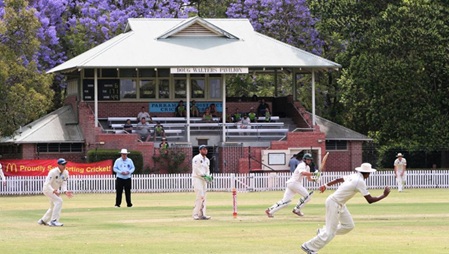
By far the most significant change to Old Kings Oval occurred on Sunday 18th September 1994 when a gleaming new Grandstand and amenities block was officially opened and named in honour of the Parramatta club’s champion former Test Batsman Doug Walters. In Doug’s absence his wife Caroline performed the duties supported by John Haines (Lord Mayor of Parramatta) and Paul Elliott (Federal Labor Member for Parramatta) a former player with the club – the new building was an amazing upgrade to the oval, replacing its primitive eyesore of an old shed-like predecessor.
Across a period ranging from 2002/03 through to 2021/22 the Parramatta District Cricket Club has worked in conjunction with the park Trust to install several capital improvements to Old Kings Oval. Through a combination of self-fund-raising activities, together with the acquisition of various Cricket NSW and Government grants the club has initiated the following improvements:
- 2002/03 – installed four retractable practice nets for use on the turf training wickets.
- 2002/03 – expanded the turf practice wicket block by extra pitch capabilities.
- 2006/07 - Upgraded the Sight Screens – known as the Wally Cornock Sight Screens in honour of a former club stalwart.
- 2007/08 – erected four all weather artificial practice nets at the northern end of the ground – known as the Benaud nets in honour of the club’s famous family.
- 2007/08 – installed a pop-up sprinkler system to the centre wicket table and to the turf practice pitches.
- 2019/20 – built an electric scoreboard close to the Bankwest Stadium on the eastern side of the oval – dedicated to Richie Benaud (former club and Australian Test captain).
In 2010 funding ex the Federal Labor Governments ‘Stimulus Package’ was put to good use by the removal of a decrepit wire mesh boundary fence and replacing it with a heritage inspired wooden picket fence, the Park Trust managed and oversaw that project.
The partnership between the Parramatta District Cricket Club and the historic Parramatta Park has been in place for a matchless 160 years (1862 to 2022) – marking the cricket club as a ‘living heritage’ and the oldest continuous sporting organisation to have taken residence in this important precinct.
Prominent Artist Deborah Angus was commissioned by the Parramatta cricket club to undertake an oil painting of Old Kings Oval as a fund-raising activity towards the Benaud Electronic Scoreboard project.
By Tom Wood – Parramatta District Cricket Club Historian
Join the Captains Circle Scenario 5 - When Your Words Are Tested