

North Sydney - Fourth Grade Premiers 1968-69
UTS North Sydney District Cricket Club | January 12, 2026
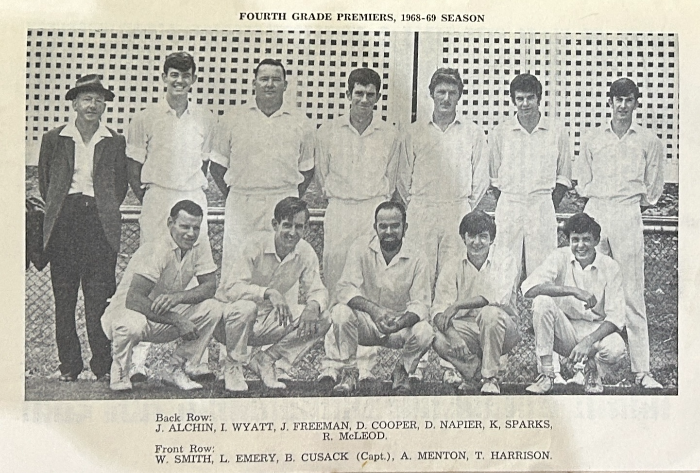
North Sydney has won only one Fourth Grade Premiership in its history, in 1968-69, with victory over Balmain under the leadership of Barry Cusack. Here we reproduce the season write-up in the club’s Annual Report, which includes a report on a roller-coaster final.
In winning the initial Fourth Grade Premiership in the club's history and in bringing Premiership honours for the first time since our First Grade success in the 1931-32 season, the Fourth Grade team brought new life and enthusiasm to all players and supporters alike.
It is perhaps coincidental that the Captain of the First Grade Premiers in 1931-32 was Immediate Past President Mr. A. H. Vincent, who was also the Captain of the Fourth Grade side in 1934-35, the year in which the competition was inaugurated. Discontinued in 1938, the grade was not introduced again until the 1948-49 season when the club team finished in 5th position. However, with few exceptions our sies have occupied the lower rungs of the competitive ladder for the previous season, 1967-68, were fortunate to win the last two games to lift the team from last position to 14th. Consequently, not even the most optimistic supporter forecast prior to the commencement of the season that the team would lead the competition from the third round and maintain their position through to the final fixture. It is believed it also gained a record number of points, 101, for any competition conducted by the N.S.W.C.A.
Premierships in any grade of cricket are not easily gained but are hard-earned and generally the result of enthusiastic team work rather than the outstanding performances by one or two individuals. Each member of our Fourth Grade team responded magnificently to the inspiration and example of its Captain, Barry Cusack. It was this team spirit more than any other factor which carried the side to victory.
As circumstances demanded, batsmen fought strongly down to No. 11 and bowlers rose to the occasion when matches appeared to be lost or in balance, whilst the catching and ground fielding maintained constant pressure on opponents. As a team, the side went from strength to strength to the tense climax of victory in the final against a worthy opponent, Balmain, when each run scored, each wicket taken and each run saved counted so much to either side.
Sent in late on the first day on a rain-affected wicket, team started disastrously with Bill Smith being run-out without scoring and completed the day's play with 6 wickets down for 38. The lower order batsmen continued the struggle on the second day under similar conditions to take the score to 76. In reply, Balmain appeared to be steadily gaining a winning position when Derek Napier struck with a fiery spell of fast bowling and, supported by some terrific catching, routed the opposition to take 7 wickets for 28 runs, leaving Balmain 23 short of a first innings lead. However, the match was far from over as the home team battled against time to withstand a last ditch effort from the Balmain bowlers. Rain, which had been threatening most of the day, finally ended the struggle at 4.30 p.m. with Keith Rodgie, in particular, stoutly resisting the all-out attack.
Thus the final was won after a season in which each player contributed to the ultimate success.
Barry Cusack proved an astute captain who was able to lift his side by precept and example. Although his highest score was 50, his consistency was invaluable, whilst he captured 38 wickets at low cost with his medium-paced bowling. Derek Napier in addition to his sterling effort in the final, took most wickets (45) and finished second in both batting and bowling averages.
Jim Freeman not only won the bowling honours with his leg spinners, but in doing so broke the previous record with an average of 8.37 runs per wicket. Included in a number of outstanding performances, he took a hat-trick against Western Suburbs, the first ever by a Fourth Grade player for the club.
Nigel Bill, who played in a limited number of fixtures during school vacation, displayed commendable application as an opening batsman to head the batting averages.
Trevor Harrison matured considerably during the season, proving a stalwart as an opening batsman with the highest aggregate (398 runs) and lending valuable support with his leg-spin bowling to take 22 wickets.
Keith Sparks gave many big-hearted performances with both bat and ball in capturing 41 wickets and compiling 298 runs. His capable assistance as Team Secretary was also greatly appreciated.
Alan Menton and Langdon Emery each took 10 catches, which they backed up with excellent ground fielding and stood out in a team which maintained a very high standard throughout the season. Alan is an aggressive batsman and a promising spin bowler who could develop into a fine all-round cricketer. Langdon's team spirit was contagious and a wonderful asset which cannot be measured in the usual terms of cricket statistics.
Dennis Cooper displayed outstanding talent as wicketkeeper. Although, naturally for one all young, lacking a little polish, he proved his effectiveness with a season's tally of 16 catches and 12 stumpings. He also rescued the team on occasions with some solid innings.
Robert McLeod and Ian Wyatt had restricted opportunities to make use of their high potential and should develop into very capable players within the next few years.
To other members of the team who participated in only a few matches, particularly Keith Rodgie, Angus Blair, Terry Hogan, Noel Nelson and Pat Nelson, the team was very appreciative for their individual contributions.
Sincere thanks are extended to Mr. John Alchin for his constant support, to Mr. N. Robinson who acted as scorer for the final, and to Mesdames Harrison, McLeod and Cusack in providing afternoon teas and lunch on both days of the final.
BeaconPoint Spotlight with Paul Ryan – Batting Techniques, Accountability, and the Future of Australian Cricket