
A talent lost: Ronald Lockrey
Gordon District Cricket Club | November 28, 2025
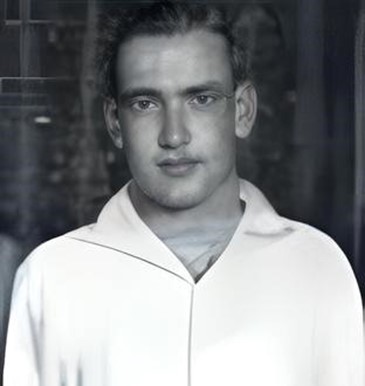
Ronald Lockrey started at North Sydney High School in 1935 and graduated in 1938. While in his last year at school he was chosen in the very first A.W. Green Shield team for Gordon in the 1937-38 season.
The 1937-38 NSW Cricket Association Annual Report recorded the beginning of the AW Green Shield competition. ‘The Shield donated by FM Cush and RG Herford for a competition confined to schoolboys within the territories of the District Clubs was handed to the Association and was designated the AW Green Shield, to perpetuate the memory of the Association’s late President. Alfred William Green had a long career as an official of the NSW Cricket Association.
A competition for schoolboys under the age of seventeen years and resident within the territories of the District Clubs was inaugurated, matches being played on grade grounds on Saturday mornings during school term.’
‘Three matches were played prior to the school vacation, and three subsequent to that vacation, and the competition proved a success. The competition was won by St George DCC, with Gordon DCC second and North Sydney DCC third.’
Gordon had four wins (two outright) and one loss during the season and one of the leading bowlers for Gordon Ron Lockrey (10 at 7.40).
It was after leaving school that his cricket career started in earnest with nine games in the Fourth Grade team after Christmas where his ability as a batsman started to shine when he scored 418 runs in nine innings with four not outs and an average of 83.10. This included a score of 105. The next season (1939-40) was also productive, with 288 runs in Fourth grade and another century and 227 runs in Third grade, totalling 515 runs for the season. What a talent!
Due to his studies Ronald’s cricket was restricted in 1940, however, was able to play several Third Grade games and helped them in winning the 1940-41 Premiership.
Even though he was only eighteen, Ronald, like many others of his age at the time of the outbreak of war, was determined to serve his country and enlisted on 19 July 1941.
Like a lot of other Australian servicemen, there was a particular attraction for Gordon cricketers to join the Royal Australian Air Force. While the exact number amongst those listed on the Honour Board is not known, those who can be identified through their war records as having joined the RAAF were players Ronald Lockrey, Gordon Thame, Jack McDonagh, Norm Spalding, John Wearne, Dave Robinson, Jack Quigley, Reg Giddey, Jack Pettiford, Jack Potter, Basil Sheidow and Dave Evans.
With the decision of the Government to send its RAAF personnel to the UK at the start of the war, Ronald was one eight of the Gordon airmen who signed up to the Empire Air Training Scheme (EATS), and after graduating was posted to the Australian RAF No. 460 Squadron at Binbrook in Lincolnshire on 22 April 1943
On his arrival, Ronald was assigned to a Lancaster crew as follows:
Sergeant William Henry Bartlett Navigator)
Sergeant Stanley Kenneth Brown (Wireless Operator)
Sergeant Jack Sidney Callcut (Flight Engineer)
Sergeant Kenneth Albert Charles Cotton (Air Gunner)
Flying Officer Leonard Eric Harrison (Pilot)
Flying Officer Robert Jarvis Heffernan (Bomb Aimer)
Flight Sergeant Ronald John Lockrey (Air Gunner)
His role as an air gunner positioned him in the front turret of the aircraft, by far the most dangerous position one could imagine.
A mission was established for a bombing raid on Mulheim in Germany near Duisberg, Essen and Dusseldorf. Many aircraft formed the attack across several squadrons and were carrying 1,643 bombs. Ronald’s EE166 Lancaster was part of the mission which took off at 23.15 hrs.
On 22-23 June 1943 at Mulheim, the skies were clear and the Pathfinder aircraft had no difficulty in giving a reliable aiming point for the bomber stream throughout the attack. Five large steelworks were hit and dense fires gradually merged into a sea of flames in the closely built-up area of the town where the main railway station, public buildings, business houses, and homes suffered extensively. Mulheim, however, was described by one Australian as ‘the hottest target yet encountered’ for both here, and at Oberhausen, the local defences were joined by those of Duisburg, Essen, Dusseldorf and Venlo which ringed the area.
The squadron was surrounded by gunfire on that night and little did Ronald know that as the Air Gunner, he would be facing the Luftwaffe Night Fighter pilot Hauptmann Wilhelm Herget who had been despatched from Venlo airfield in the Netherlands flying a Bf110 Messerschmitt. This aircraft was recognised as Luftwaffe’s premier offensive fighter with its range and speed and ability to carry heavy armament. Three days earlier on June 20, Herget had received the ‘Knight's Cross of the Iron Cross’ due to his 31 aerial victories and the destruction of five ground targets.
Herget was on target that night and Ronald’s EE166 was hit front on, going into a spiral of flames and crashing at a mill near Mulheim-Heissen. There were no survivors.
Ronald Lockrey was one of the six Gordon cricketer airmen who died in the war. Jack Quigley, Reg Giddey, Jack Pettiford, Jack Potter, Basil Sheidow and Dave Evans survived and went on to have wonderful careers with Gordon.
Nineteen year old Ronald Lockrey had no chance that night and while he might have been only a statistic amongst the many thousands who died in aircraft defending the UK, he will never be forgotten by the Gordon District Cricket Club as a player who played in the very first Green Shield team and paid the ultimate sacrifice for the love of his country and his cricket club. When the Green Shield squad forms this season it should remember the role that people like Ronald Lockrey played in establishing the Green Shield now for nearly 90 years.

Clip from BeaconPoint Family Forum - How can parents teach their kids to embrace anxiety in a positive way?