
Who would deny Harry his time off during the war?
Gordon District Cricket Club | August 02, 2025
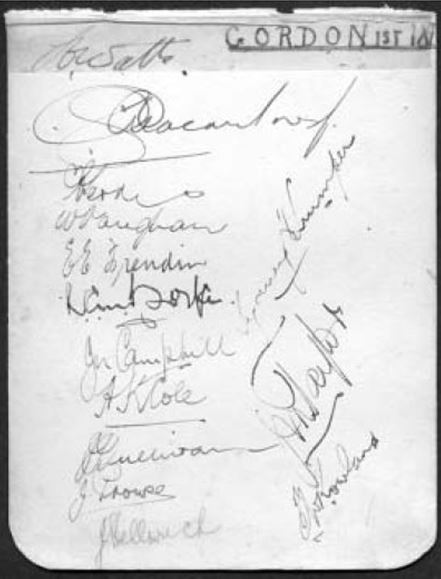
Harold (Harry) Watts enlisted in the 9th Machine Gun Company of the 3rd Division of the Australian Imperial Force (AIF) in March 1916 and eventually joined them in November 1916. He was a warehouse salesman and lived at Station House in Chatswood. Harry was only twenty when he enlisted and required the written permission of his parents which was duly given. He was a very promising young cricketer who played fourteen games in his first season with the club in 1914-15 as an eighteen year old. He scored 462 runs at an average of 42, with a top score of 76. Due to the number of players leaving for the war in 1915-16, he was promoted to First Grade and played thirteen games. He wasn’t as successful as the season before but did have a high score of 57.
After training in Australia and the UK, Harry was deployed to the Western Front in France and Belgium. His first major battle was the Battle of Messines in June 1917 – which was the 3rd Division's first major battle in Europe, where they were part of the successful assault on Messines Ridge.
Harry’s company played a key role during the battle where they provided vital fire support for the infantry assault. Prior to the famous mine detonations that launched the battle on June 7th, machine gun crews were positioned strategically to deliver covering fire. Once the attack began, they employed their Vickers machine guns in a barrage capacity, creating curtains of fire that advanced ahead of the infantry.
Harry and his company were praised for maintaining effective fire despite being targeted by German artillery and facing difficult terrain. Their mobility and quick deployment helped secure the 3rd Division's objectives during what was considered one of the most successful Allied operations of the war to that point.
In October 1917, the 3rd and 4th Divisions at Passchendaele contained four Gordon cricketers: Harry Watts, Johnnie Moyes, Dr Gother Clarke, and Harold Lilja. During this notoriously brutal campaign, the 9th Machine Gun Company supported the 3rd Division's infantry battalions in several phases of the battle, particularly during operations at Polygon Wood (September 26, 1917) and Broodseinde Ridge (October 4, 1917). Their Vickers machine guns provided crucial fire support during both the advance and in consolidating captured positions. The battle conditions were exceptionally challenging, with torrential rain turning the battlefield into a muddy quagmire that made moving the heavy Vickers guns and ammunition extremely difficult. Many machine gun positions became isolated islands in a sea of mud.
Like all units involved at Passchendaele, the 9th suffered significant casualties while contending with artillery fire, gas attacks, and the appalling weather and ground conditions that made this battle one of the most gruelling on the Western Front. The disaster of the Battle of Passchendaele was summed up in nine words by Johnnie Moyes in his personal diary: almost every man who showed himself became a casualty. Harry spent several months in hospital after being very badly gassed during the battle.
A month before moving out of Belgium, Harry, who was due to return from leave in England on 9 February, couldn’t be found. It happened that his company was again camped in the village of Neuve-Eglise, where he had spent a night out of billets back in June 1917. This time, Harry was out of camp from 7am on 9 February, to 10am on 12 February. Either Harry spent the time in the village or maybe he could have been a few miles away in the village of Armentières.
In February 1918, the 9th company had moved down through the Belgium city of Ploegstreert to the advance headquarters of the 9th Brigade in Le Bizet. Le Bizet of course is just over the border from the French city of Armentieres. The February war diary record of Harry Watts states he went AWL from February 9th to February 12, 1918 and was docked 14 days’ pay.
'Oh, Mademoiselle from Armentieres,
Parlez-vous
Mademoiselle from Armentieres,
Parlez-vous,
You didn't have to know her long,
To know the reason men go wrong!
Hinky-dinky parlez-vous'
Hopefully the 4 days were worth it for Harry.
After returning to the front line Harry was confronted with the German Spring Offensive when the Germans launched their last major offensive Somehow surviving this period Harry found himself again in the front line as the enemy troops forged their way toward Amiens and pushed the British and Australian troops back to Villers-Bretonneux.
After initially losing control of the town a counter-attack was primarily conducted by Australian forces and by dawn on April 25, the Australians had successfully recaptured most of Villers-Bretonneux and halted the German advance toward Amiens. This successful defence marked a turning point on the Western Front, effectively ending the German offensive capabilities in this sector. Harry was badly gassed again in this battle and was transported to the field hospital at Étaples. After his last poisoning, it was necessary for him to convalesce from May 1918 to the end of the war in England and in early 1919, Harry worked in the 2nd Australian Auxiliary Hospital in Southall while possibly getting in some cricket in May and June before his return to Australia in July 1919.
Harry married Mary Pawsey in 1922 and they lived at 48 Elizabeth Street, Artarmon. He was one of the fortunate ones who continued his cricket career after the war, playing twenty-two consecutive seasons with Gordon until the 1940-41 season. As World War II was having an impact on the playing strength at Gordon, Harry was asked to play a final season in the Gordon Vets team in the 1942-43 season. In what would have been an excellent photo opportunity, Harry played alongside Bert Oldfield, both men now being in their late 40s. During the season, Harry was asked to fill in for Second Grade and batted four times. He scored 4 runs. He finished with 6,629 runs at an average of 25 over his long career and is in 14th position for runs scored. Harry died in October 1967 at the age of seventy-one.
Harry fought mainly on the front line within the 3rd Division famously led by Sir John Monash, from November 1916 to May 1918 during the most difficult time of the war and in the worst conditions imaginable. If you happen to be driving up Elizabeth Street near the intersection of Mowbray Road on the way to the oval wave a thank you salute to his house which is still standing today.
What a legend!!
Paul Stephenson

BeaconPoint Club Clips - The Captains Circle with Moises Henriques