

Gordon's top four wicketkeepers
Gordon District Cricket Club | July 27, 2025
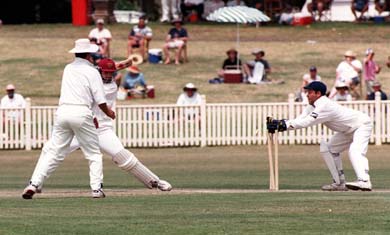
The Gordon District Cricket Club seemed to be always blessed with very good wicketkeepers. Each of these Australian wicketkeepers who played for the club, Bert Oldfield, Brian Taber, Adam Gilchrist, and Phil Emery, brought distinct skills and qualities to their craft, adapting their approaches to the eras in which they played. Here’s a comparison of their wicketkeeping styles, strengths, and impact on the game.
Bert Oldfield
Bert Oldfield, active in the 1920s and 1930s, is widely regarded as one of the finest wicketkeepers in cricket history. Known for his incredible reflexes, safe hands, and almost acrobatic movements, Oldfield mastered the art of standing up to the stumps, even to quicker bowlers. He excelled on challenging pitches, where his agility shone. Oldfield’s skill level was remarkable given the era’s less forgiving equipment and uncovered pitches, making his achievements all the more impressive.
Oldfield’s ability keeping to spinners was also renowned and this is shown by the fact that while he took 398 catches in first class cricket, he also made 264 stumpings which was an incredible 40% of his dismissals. No other keeper got close to this percentage. Due to his Test and NSW commitments, he played irregularly for Gordon taking 66 catches and making 41 stumpings.
Brian Taber
Brian Taber played his initial First Grade game for Gordon in 1956 as a 16 year old and retired 19 seasons later during the 1974-75 season. He made his Test debut in 1966 during a tour of South Africa and played in 16 Tests and 129 First Class games. Taber was particularly known for his technical solidity and resilience. While not as flashy as Oldfield, he was known for his reliable glove work and exceptional consistency, rarely making mistakes behind the stumps. He was often praised for his ability to handle Australia’s diverse bowling attack. Taber's strengths lay in his judgment and anticipation, crucial qualities that served him well, particularly on challenging Australian pitches. He also emphasized quiet efficiency, focusing on doing his job without drawing attention to himself.
During his career at Gordon Taber took 227 catches and made 123 stumpings. While at 35% this is a close percentage of stumpings compared to Oldfield, he only made 50 stumpings in First Class cricket to go with his 345 catches. The advantage Brian had during his career at Gordon was the presence of some excellent leg spin bowlers in the form of Dick Guy (786 wickets), Reg Giddey (452), John Todd (260) and Tony Wilson (102). Brian was also a very capable batsman who scored 4,368 runs for Gordon at 24.96 with a highest score of 138 not out.
Adam Gilchrist
Adam Gilchrist only played three seasons with Gordon which included two premierships. Adam had the misfortune of having Phil Emery, the First Grade and eventual NSW captain in the side meaning he didn’t get to keep for Gordon. In his three seasons he batted 39 times scoring 1,199 runs at 36.33. Adam left NSW at the end of the 1991-92 season to go to Western Australia and as they say: “The rest is history”. Gilchrist revolutionized the role of wicketkeeper-batsman in the late 1990s and 2000s, combining explosive batting with sharp wicketkeeping skills. Though initially seen as more of a batsman, Gilchrist’s keeping abilities developed rapidly, especially his agility and adaptability to different conditions. He stood out for his athleticism and willingness to take risks, although some critics felt his keeping, especially to spinners, wasn’t quite as polished as some of his predecessors. However, his ability to contribute heavily with the bat made him an invaluable player, setting new standards for the role.
Phil Emery
Phil Emery made his First Grade debut in 1983 when he was promoted through the grades from 4th Grade and the top side. Like Gilchrist, Phil was also a very good batsman and overall scored 5056 runs for Gordon at an average of 31.21. As a keeper Phil took 272 catches and 29 stumpings. His low number of stumpings probably indicates the strength of the fast bowling during his career with the club with Richard Stobo and Warwick Adlam leading the way. While off spinner John Davison played also during that time, the opportunities for stumpings weren’t as prolific as the bowlers in the 30’s and 60’s.
Phil was a respected wicketkeeper known for his sound technique and reliability. Though his international career was brief due to competition from Ian Healy, Emery excelled in domestic cricket, where he captained New South Wales. His skills were marked by excellent footwork and dependable glovework, especially to spinners, a quality valued highly in Australian conditions. Emery’s style was understated yet effective, embodying a classic approach to wicketkeeping. Phil took 332 catches and 46 stumpings for NSW during his career.
Comparison Summary
- Glovework: Oldfield was the benchmark for glovework in challenging conditions, while Taber’s consistency and Gilchrist’s athleticism made them outstanding in their own ways. Emery provided reliable, steady work at a domestic level.
- Agility and Adaptability: Gilchrist was the most agile, with his athleticism allowing for spectacular takes, while Oldfield’s fast reflexes were legendary.
- Impact on the Role: Gilchrist transformed expectations for wicketkeeper-batsmen. Oldfield and Taber, however, set traditional standards of pure keeping excellence, while Emery exemplified classical keeping technique.
Each player contributed uniquely to the evolution of wicketkeeping, setting high standards for future Australian and Gordon keepers.

BeaconPoint Club Clips - The Captains Circle with Moises Henriques