
St George Cricketers - Educators on the pitch and behind the pickets
St George Cricket Club | July 25, 2025
When one considers that some 485 players have appeared in first grade for the St George District Cricket Club since the 1921-22 season when the club entered the first-grade competition there have only been around thirty known players that were school teachers. That equates to 6.1 % in its history. Some players had cameo appearances in first grade whilst others a lengthier sojourn.
If one were to carry out an analysis of professions or vocations at the club it is certainly varied. There has been train drivers, professional cricketers, lawyers, insurance brokers and underwriters, grocers, a secretary of the Communist Party, a Reverend, engineers, a police prosecutor, politicians, printers, potato market wholesalers, dare I say tobacco salesmen, accountants, television producers and film makers. A variety in every way.
Bill O’Reilly joined the club for the 1934-35 season having spent time in the country as a teacher at Griffith, Rylstone, and Kandos. There was also time in a classroom at Erskineville. His time in the country were interrupted years, with his cricket days at the North Sydney DCC somewhat limited. In 1931 there was a move for O’Reilly in the state system to Kogarah Boys’ Intermediate High School. Following marriage to Molly and the arrival of their daughter, Patricia, he moved to private school teaching at Sydney Grammar School, sharing his wide knowledge in English, History and Business Principals. There would have never been a boring moment in O’Reilly’s classes.
Whilst playing at St George it was obvious that the relationship skills that O’Reilly had refined in the classroom were there for all to see when he got beside and encouraged the cricket careers of Arthur Morris, Bob and Vic Cristofani and Ray Lindwall. Morris once commented to this writer.
Bill had it all. He had us in his hands. When he spoke, he was the teacher we needed in our cricket and personal lives.
Morris left the club in 1950 in protest about the treatment handed out to O’Reilly. It really was the pupil following the teacher. Having graduated from Sydney Teachers College in 1925 O’Reilly gave away teaching in 1939, worked with Stan McCabe at his Sports Store and then joined the Lion Tile Company in 1941. It was a school teaching career of only 14 years but in the following 53 years a life education of sharing with cricket writers and cricketers.
Brothers Bob and Vic Cristofani were around the club in their formative years. Bob played for NSW and the Australian Services team in 1945. Vic was a great theorist on the game. At Sydney Teachers College he approached his studies by working at night from ‘midnight to four, then sleeping till 8.45am awaking in time for lectures’. He said to this writer. ‘The mind is fresher in the earlier hours and retains a lot.’ Whether this helped him in his brief teaching career is unknown but for St George he scored 2559 runs at 27.52 and took 49 wickets at 20.31. He played in a number of premiership sides with a theory in his mind that he shared with captain Warren Saunders on the morning of a final as to how they could win the game. There were also seasons at Western Suburbs and Sydney University. Cristofani spent a lifetime at the ABC as well as many years in the ACT as their cricket coach.
The story of Brian Booths departure from the classroom to the Sydney Cricket Ground on 18 February 1955 has been recalled over the years.
It was Booth’s second appearance for the state that has gone down in true Boys Own Annual Stories folklore.
You see Brian was a schoolteacher at Hurlstone Agricultural College at Glenfield, 27 miles, as it then was or 36 kilometres from Sydney. He was in his third week at the school. The phone in the office of the headmaster, Clarrie James rang at around 9.20am. The caller wanted to speak to Brian Booth who was located and subsequently took the call.
Its Alan Barnes from the Cricket Association would you be able to play against the MCC at the Sydney Cricket Ground today. Arthur Morris and Billy Watson have had to withdraw from the match due to the aftereffects of inoculations for the upcoming West Indies tour.
Booth excused himself from the call and said to James.
Can I play, yes was the reply.
Returning to the call Booth said
Mr Barnes I’ll come straight away, but I may be a bit late as I will have to come by train.
That does not matter said Barnes. As long as I know you are on your way, he said with a laugh. There are others who will hold the fort till you get there. Get a taxi from Central Station.: we’ll pay.
You will appreciate that it was a magnanimous financial gesture from Barnes, the keeper of the Associations coffers to pay Brian’s fare.
Booth raced back to his room, packed some of his cricket gear and just caught the 9.48 Campbelltown Terror from Glenfield Station. The train trip was an agonising 70 minutes. Many thoughts as Booth later recalled went through his mind, a failure at the SCG a few weeks earlier, limited opportunities in playing for NSW in a strong XI and those games in the backyard at Perthville with his father ‘Snowy’ Booth.
When the train pulled into Central railway station it was 10.58 and Booth dashed to the taxi rank for the trip to the SCG. Not really knowing where to go Booth finally found the members entrance, saying to the green coated attendant,
Excuse me my name is Booth I have been asked to play today.
Grinning the attendant said
Come in, they’re expecting you. Straight ahead and up the steps to the dressing room. Good luck mate.
Booth takes up the story.
As I approached the rooms, I saw the scoreboard showing 11.35 and the score 3 for 12. Jimmy Burke apologised that skipper Keith Miller was batting and not on hand to greet me. I started to pad up and then heard a roar from the crowd. Miller was out and it was 4 for 16.
Get your pads on Booth.
was the cry in the dressing room.
You are next in.
Simpson was out and the score was 5 for 26., Briggs 0, Burke 0, Benaud 1, Miller 11, Simpson 6. As Booth walked out to bat Keith Miller seeking to give some confidence and putting his hand on the shoulder of the 22-year-old said
Good luck, Brian. There is a bloke out there named Tyson. He’s a bit quicker than anyone you have met in grade cricket. The only advice I can give you is, don’t lift your bat too high on the back lift.
As Booth walked out to bat Alan McGilvray in the ABC commentary box said to the radio audience , Its Booth to Bat, the title subsequently given to the cricketers widely sold autobiography.
Tyson bowled from an exceptionally long run. Booth was hit above the pad from two successive balls. He was not aware of thigh pads in those days. – his country advisers contained their advice to a bat, gloves, and protector. Booth weathered the bowling of Tyson, Bedser and Wardle to be 74* in 235 minutes at the conclusion of the NSW first innings.
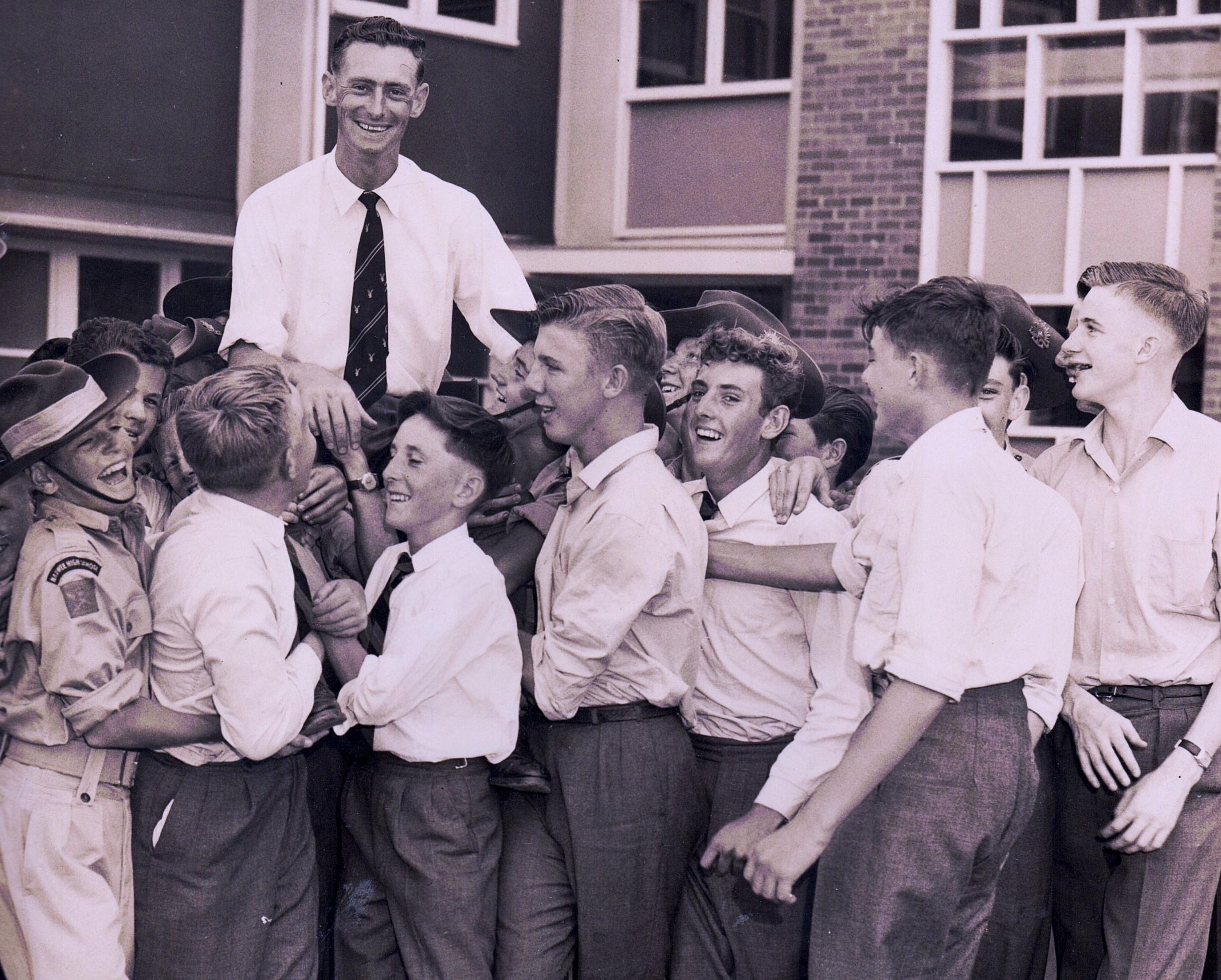
For Brian, education was his vocation, firstly at Hurlstone Agricultural College and then Narwee Boys’ High School. It was then the education of students at Sydney University where he was a lecturer in the School of Human Movement. Many people over the years have shared stories of Brian’s character and mindfulness when it came to cricket.
There were those he mentored, encouraged, and ensured trod a path that would be beneficial to them. Recently Trent Copeland passed on his appreciation of Brian’s cricket teaching and leadership. His calm teaching style certainly was always evident and on show. Teaching however paid him no favours financially. For his tours overseas to England in 1961 and 1964, West Indies 1965 and New Zealand in 1960 and 1967 it was leave without pay. The Education Department of NSW took no prisoners when it came to providing for teachers who represented their country.
Paul Bourke was a member of the illustrious St George DCC Poidevin-Gray side that won the shield in the 1975-76 season. It was a strong side with the former Dubbo cricketer, who had been coached by Peter Leslie at school, finding his place in Sydney grade cricket. In the team were two other players, Murray Bennett and Jon Jobson who were to also enter the teaching profession.
Bourke played with St George for 12 seasons before joining the Campbeltown Cricket Club and playing with them when they entered the Sydney grade competition 1985-86 for three seasons. Along with his cricket at St George, 2659 runs at 26.59 in first grade to go with his seven cherished wickets his teaching career was one for the ages. He was at Newington College for 35 years as a classroom teacher including as head of the senior school before taking on the role as a ‘pastoral carer’. Bourke has no compunction in saying that teaching and cricket go together.
There is the theory and then the practical application. One needs to ensure there is teamwork and in every way know the game and what it is all about.
Continuing he notes that.
relationships and skills are important, with education setting the ground rules.
Finally, he says that the often-quoted words.
once a teacher always a teacher rings true.

Paul Bourke in the classroom at Newington
Jon Jobson, also from the county, Taree, to be precise played his cricket totally committed to the cause. Influenced by his father and those on his cricket pathway Jobson came to Sydney seeking to advance his cricket career. Teaching became the chosen vocation with time firstly as a Primary School teacher and subsequently retraining as a senior schoolteacher in history. There was time at Narwee and Hurstville Boys’ High before Endeavour Sports High School where he utilised his sound teaching skills both in the classroom and out in the centre of the cricket oval. Jobson’s career at St George spanned nearly 50 years as a player, President and Chief Executive Officer.
He was highly regarded as a coach, one who had the ability to impart his knowledge. Putting it simply that’s teaching. His club career saw him score 5,950 runs at 30.05 and lead the club to a first -grade premiership in the 1984-85 season. It was an impressive record for Jobson in junior cricket where education is important in the formative years of young people. He coached the St George Green Shield teams to two premierships and on one occasion State Challenge winners. Aa an umpire when his St George commitments had concluded he was awarded umpire of the year in second grade, before reaching first grade.
Murray Bennett seems to have always been around. At Beverly Hills Primary School this writer recalls him as being quite, somewhat reserved but always interested in ball games, soccer in the winter and perhaps by default cricket in the summer. On leaving school it was Teachers College, a safe, sure, and honourable career. It was to last for nine years before an offer to join Warren Saunders Insurance Brokers Pty Ltd presented itself.
Education was important to me says Bennett.
It gave me a foundation on which to build. It has been helpful in my working like in being organised and efficient in what I have done.
Bennett however recognised after his tour to England with the 1985 Australian Touring team that education may not always pay the bills.
I received $35,000 for a five-month tour and was getting $29,000 a year as a teacher. It just did not add up.
Bennett does acknowledge the importance of education. Sport as he recognises is the beneficiary of a good education. Bennett as a leader has had much to offer as a captain, selector, coach, mentor, and businessman. Along the way education played its part in allowing Bennett to play for NSW and Australia scoring 3,973 runs at 24.08 and take 485 wickets at 17.62 in first grade.
Back in the 1960’s two players John Rogers and Peter Leslie graced the playing fields of suburban Sydney and for short periods the first-class grounds of Australia. Peter, born at Hurstville, and John in Gosford, both became schoolteachers.
During the 1960s when St George won four premierships in six years, batsman John Rogers was briefly a schoolteacher before leaving to work for Richie Benaud’s marketing business for two years 1970–72 and in 1980 became General Manager of the Western Australian Cricket Association for six years.
Peter made his debut for NSW in the 1965-66 season, against the MCC, being called up late, and having to take time off from teachers College. After graduating from Teachers College, he was given teaching appointments at Wagga Wagga, Pennant Hills High, Canterbury Boys’ High and Cronulla High.
When he was appointed to Wagga Wagga he was told in no uncertain terms that despite the fact that he was a first-class player he was still going to the country. Warren Saunders needed his state bowler for grade cricket, as there were games to play and premierships to win. After discussions with some senior NSW Education officials including Dr Harry Wyndham and the former Sydney Council Town Clerk, Ted Adams, a former NSW and St George cricketer, Leslie was appointed to Canterbury Boys’ High. It’s not always who you know but how you put it and in Leslie’s case it worked.
In 1971 Leslie was transferred to the country where he became the physical education teacher at Dubbo High. It was during these years that he imparted his cricket and football knowledge to those at school and on the sporting fields in the Western Districts. It of course continued to Northern NSW when he moved there in the 1980’s.
He was highly regarded as a teacher, able to mix it with the students on an off the field. Education was the big teacher. Many cricketers came under Leslie’s influence, many moving into representative teams. Peter was an extraordinarily talented sportsman. Warren Saunders once said there were three cricketers that he had played with in his life that exhibited wonderful natural talent. Peter was one of them and with that gifting in his DNA he was always going to be a quality teacher, and a wonderful person as well.
Coming into the game somewhat late was Steve Wark. The former student from James Ruse High connected with the club through friends of Harry Solomons. It wasn’t long before the gifted allrounder was making his mark, playing, and mixing it with the likes of Pilon, Green, Catalano, and a young Hamish Solomons. For Wark it was a late entry into teaching. After graduating from Macquarie University, he spent time with the NSW Public Service in the Police Department and at the age of 23, as a mature age student, added a Diploma of Education from Western Sydney University. In essence his career in teaching has been at Merrylands High School, firstly as a teacher and now as Deputy Principal.
Wark says in a very firm way.
You have values as a teacher, and you impart those values to those you teach. Interesting at St George the values I have in my career are on show across the club.
As to how teaching has a relationship with cricket Wark says.
In the school where I teach there are many children from a variety of socio and cultural backgrounds. I suggest to the students regularly that they should develop a sporting interest outside of school as that will enable them to integrate and grow in life and the community.
As a leader and educator Wark is seeking to have influence, with cricket both on and off the field having a part to play. ‘
Education at different levels is a value maker for the individual and sets them on a path for their future.
The Merrylands school motto, Truth without Fear has an educational ring which no doubt Deputy Principal Wark seeks to pursue.
Cricket and education have been joined at the hip for the current St George opener and sometime captain, Matt Rodgers. Having played grade cricket for near on 13 years with the Sydney and St George club sides, winning a few premierships along the way there is a depth in many ways to his cricket and educational life. From beyond the picket fence he is a player who takes it all before him, demonstrates good leadership and goes about his life and cricket in a quiet way. Currently in England teaching and playing cricket there is an education process occurring on the other side of the world.

Steve Wark demonstrating the "school teacher glare" perhaps?
Rodgers feels that as a captain he has learnt much and been able as a teacher to apply it in the classroom. He says.
Clarity of communication is crucial. I’ve learned that everyone responds well to a clear simple message. When you speak in front of a team or class you only have a short amount of time before people tune out. So being really clear on what you want to say and to not waste your words. You need to ensure that everyone is on the same page. Having regular check ins is another important aspect in both environments.
In seeking to understand the thinking today of being a schoolteacher and where it sits in developing a cricket career Rodgers is sincere by saying that
I believe teaching has assisted my cricket in a number of ways. It has provided me with a nice balance away from cricket but also allowed me enough time to train throughout the week. Regardless of if I’ve had a good or bad weekend at cricket, it doesn’t really matter to the 30 year three kids in front of me on Monday morning. So, learning to separate the two has been important.
Rodgers is of the view that there are teaching skill sets that have an application in cricket.
The planning and preparation side of teaching has helped me in all aspects of my life. Being clear about what I want to get out of a training session and similarities to the lessons in a classroom.
Cricket according to the St George opener is also a good teacher. There is one word that comes to mind - patience.
As a batsman you always want to score runs and as a teacher you always want your kids to learn things right away. But we know in both environments that’s not always realistic. Staying patient and trusting the work you do definitely overlap and have been an ongoing theme between the two.
Salient words and thoughts from a current St George player that we should not only ponder but consider as to whether there are applications in our own lives.
In a list, that is probably not complete, we can include the following teachers that have played first grade for St George DCC:- Gary Goodman, Colin Carpenter, Marty Sinclair, Mark Curry, David Moore, Dave Roberts, David Cohen, Trevor McDonald, George Stamatopoulos, Rob Smith, Peter Wooden, Damien Bourke, Tim Laws, Matt Hoggett, Luke Reynolds, Dave Williams, Andrew Walsh, Chris MacDougal. Mitch Gray, Josh Moors and Jacob Wood.
Teachers are effective if they understand young people and can assist in their development as a person. These qualities have certainly flowed into the cricket world. That is not to say that other vocations or professions have not had a part to play in educating cricketers.
At St George District Cricket Club there have been many people that have supported and encouraged players. Two not discussed with a teaching background are President Kevin Greene and former NSW player and Australian team manager, Steve Bernard.
Kevin has been involved with the club in many areas including team management and administration. As President of the club, he has sought to lead and direct the club in many areas. For the former state politician and educator, which saw him teach at Penshurst Marist Primary, followed by being Assistant Principal at Marist Brothers Daceyville and St Therese Mascot, teaching was a wonderful and rewarding career. He concluded his teaching at St Brendan’s Annandale as Principal.
As for Steve Bernard it was a brief encounter, one term at teacher’s college after leaving Orange High, in the Central West of NSW. He must have learnt much, and quickly as he was able to move from playing the game into the world of cricket administration firstly as a NSW then Australian selector. There was then a fifteen-year period where he was the Australian Cricket Team Manager and an ICC Referee for the following ten years. A stellar career one might say for the fast bowler selected in the St George DCC Team of the Century.
Let us remember that teachers can make such a profound input on our lives and should be honoured as heroes. At St George DCC that certainly has been the case.
RL Cardwell
2025

BeaconPoint Club Clips - The Captains Circle with Moises Henriques